
Straight Talk: Flipping Margins Narrowed Again in Q2
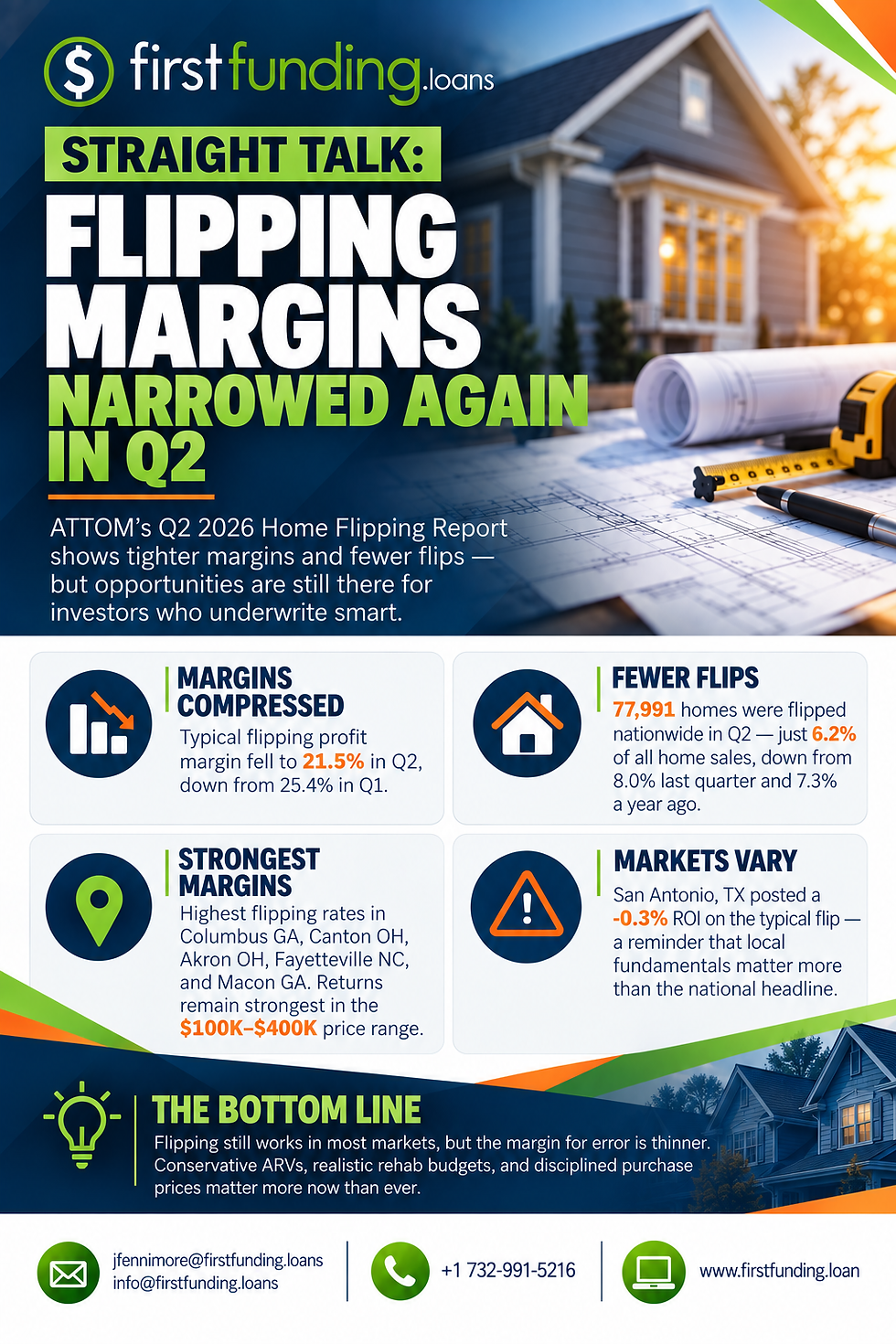
ATTOM’s Q2 2026 Home Flipping Report is out, and the latest numbers send a pretty clear message: flipping still works, but there’s less room for error.
Rather than sugarcoat the numbers, here’s what investors should be paying attention to.
Margins Compressed Again
The typical flipping profit margin fell to 21.5% in Q2, continuing the gradual decline we’ve seen over the past two years.
That’s a noticeable reversal from Q1, when margins climbed to 25.4%. If that increase looked like the beginning of a recovery, Q2 tells us otherwise.
It wasn’t a trend. It was a quarter.
For investors, that makes disciplined deal selection more important than ever.
Fewer Homes Are Being Flipped
It’s not just margins that declined. Activity slowed, too.
A total of 77,991 homes were flipped nationwide in Q2, representing 6.2% of all home sales. That’s down from 8.0% in the previous quarter and 7.3% a year earlier.
The takeaway is simple:
Fewer flips are getting done — and the average return on those deals is getting tighter.
That doesn’t mean opportunity has disappeared. It means investors have to work harder to find deals where the numbers truly make sense.
So, Where Are the Better Margins?
Some of the strongest flipping activity is showing up outside the expensive coastal markets.
Metros such as Columbus, GA; Canton, OH; Akron, OH; Fayetteville, NC; and Macon, GA ranked among the markets with the highest flipping rates.
There’s another important number worth watching: nationally, returns remain strongest for properties purchased in the $100,000–$400,000 range.
That sweet spot matters.
Move too far outside it, and acquisition costs, rehab expenses, financing costs, and resale risk can quickly eat into your profit.
A Reminder That Every Market Is Different
One market even slipped into negative territory.
San Antonio, TX posted a -0.3% ROI on the typical flip.
That’s an important reminder that there really is no single “housing market.”
National statistics can tell you the direction of the industry, but local fundamentals determine whether an individual deal works.
Purchase price. Rehab costs. Days on market. Buyer demand. Financing. Exit value.
Those numbers matter more than the headline.
What Does This Mean for Investors?
This isn’t a reason to stop flipping.
ATTOM’s numbers still show investors making money in most markets. But the days of assuming appreciation or a generous resale market will rescue an average deal are increasingly behind us.
In a tighter-margin environment, underwriting is where the money is made.
That means:
Be conservative with your ARV.
Build realistic rehab budgets.
Leave room for delays and unexpected costs.
Stay disciplined on your purchase price.
Make sure your financing supports the deal instead of consuming the
margin.
The investors who protect their profits in this environment won’t necessarily be the ones doing the most deals.
They’ll be the ones buying the right deals.
Today’s flip shouldn’t be underwritten like it’s still 2021. The opportunity is still there — but precision matters more now.
Have a Deal You’re Looking At?
Before you commit capital, make sure the numbers work from acquisition through exit.
If you’re underwriting a property and want a second set of eyes on the numbers or financing options, send it our way. We’re happy to take a look and help you determine whether the deal makes sense before you move forward.
First Funding — financing built around the deal, not just the loan.



Comments