
The 2026 Fix-and-Flip Playbook: How to Spot Deals That Actually Work
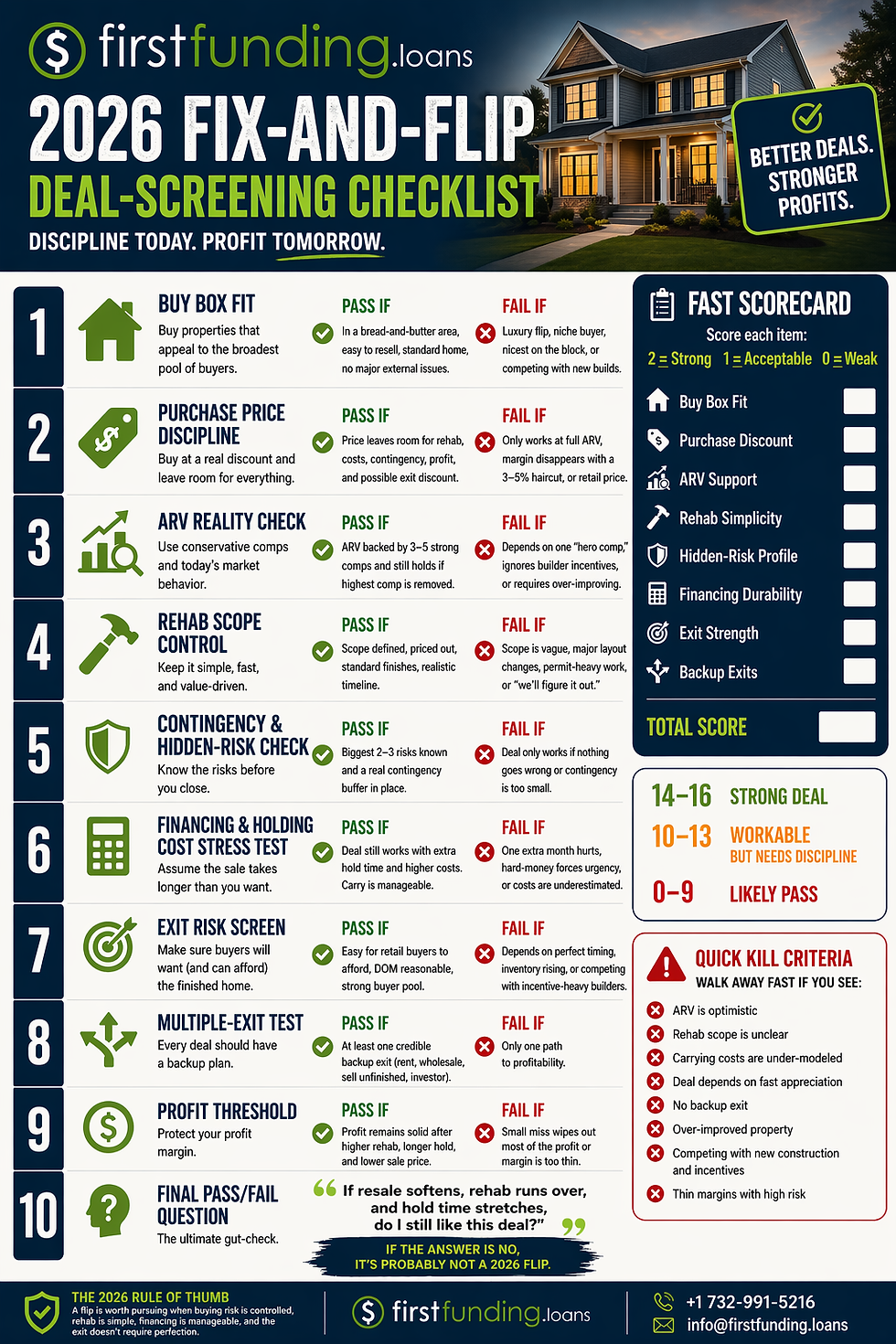
In today’s market, flipping houses isn’t about chasing hype—it’s about discipline.
Rising rates, slower buyer demand, and increased competition from builders mean that what worked a few years ago can easily fail today. If you’re serious about flipping in 2026, you need a clear, repeatable way to separate solid opportunities from risky bets.
This checklist is designed to do exactly that.
1. Start With the Right Property (“Buy Box” Matters)
Not all properties are created equal.
The best flips are simple, predictable, and appeal to the widest possible pool of buyers. Think standard homes in solid, owner-occupant neighborhoods—not niche or luxury properties.
A strong deal usually:
Sits in a desirable, easy-to-understand area
Appeals to typical financed buyers
Matches the neighborhood in price and style
Be cautious if:
It’s a luxury flip
It would become the nicest house on the block
It requires a very specific buyer
If resale isn’t obvious, it’s already risky.
2. Buy Right—or Don’t Buy at All
Everything hinges on your purchase price.
Before you even think about renovation plans, ask yourself:
Am I buying at a real discount to current value?
Does this discount protect me from surprises?
A good deal leaves room for:
Renovation costs
Carrying costs
Selling costs
Contingency
Profit
If the numbers only work at a perfect resale price—or disappear with a small price cut—you’re likely overpaying.
3. Be Ruthless With Your ARV (After Repair Value)
Optimism kills deals.
Your ARV should be based on:
Recent, nearby, and truly comparable sales
Current market behavior—not last year’s peak
Homes with similar features, not superior ones
A simple test: If you remove the highest comparable sale, does your ARV still hold up?
If not, your deal may depend on a “hero comp”—and that’s a red flag.
4. Keep the Rehab Simple
The best flips are not complicated—they’re clean.
Focus on:
Paint, flooring, kitchens, and bathrooms
Fixtures, lighting, and curb appeal
Avoid:
Major layout changes
Additions
Heavy structural or permit-driven work
If your contractor says, “We’ll figure it out as we go,” that’s not a plan—that’s a risk.
5. Plan for What Can Go Wrong
Every property has hidden risks. The difference is whether you account for them.
Before closing, understand:
Foundation condition
Water intrusion risks
Sewer/septic issues
Electrical and plumbing age
Permits, liens, or title concerns
And most importantly—have a real contingency.
If your deal only works when everything goes perfectly, it’s not a strong deal.
6. Stress-Test Your Financing
Assume the project will take longer than expected—because it often does.
Make sure you fully understand:
Interest rates and loan terms
Points and extension fees
Monthly carrying costs (taxes, insurance, utilities, HOA, etc.)
A good deal still works if:
The timeline stretches
Costs run slightly higher
If one extra month hurts badly, you’re too tight.
7. Think About the Exit First
In 2026, your exit strategy is everything.
Ask yourself:
Can a typical buyer afford this home?
Are similar homes selling—or sitting?
Are builders nearby offering incentives?
You want to be able to:
Price slightly below the top of the market
Sell within a reasonable timeframe
Compete confidently with other listings
If your success depends on perfect timing or top-dollar pricing, the risk is high.
8. Always Have a Backup Plan
A deal with only one way out is a dangerous deal.
Before moving forward, ask:
Could I rent this if the market softens?
Could I wholesale it if needed?
Could I sell it mid-project without taking a big loss?
At least one solid backup exit should exist.
9. Protect Your Profit Margin
Your profit shouldn’t disappear the moment something goes wrong.
A strong deal still works after:
Higher rehab costs
Longer hold times
Slightly lower resale prices
If a small miss wipes out your margin, the deal is too thin.
10. Ask the Final Question
Before committing, ask yourself:
“If resale softens, rehab runs over, and the timeline stretches… do I still like this deal?”
If the answer is no, walk away.
A Simple Scoring System
To quickly evaluate a deal, score each category:
Buy box fit
Purchase discount
ARV support
Rehab simplicity
Risk profile
Financing durability
Exit strength
Backup exits
Score each from 0–2:
14–16: Strong deal
10–13: Workable with discipline
0–9: Likely pass
Instant Deal Killers 🚫
Walk away quickly if you see:
Overly optimistic ARV
Unclear rehab scope
Underestimated carrying costs
Dependence on appreciation
No backup exit
Thin margins
Direct competition with incentivized new construction
The 2026 Rule of Thumb
A flip is worth pursuing when:
Buying risk is controlled, rehab is simple, financing is manageable, and the exit doesn’t require perfection.


Comments