
Where the Fix-and-Flip Market Actually Stands Right Now

If you only read the headlines, you might think the fix-and-flip market is running out of opportunities.
The numbers tell a different story.
This is not the easy, fast-rising market investors enjoyed several years ago—but it is becoming more favorable for experienced flippers who know how to find, evaluate, and finance the right properties.
Investor Confidence Is Rebounding
Sentiment among fix-and-flip investors is improving.
The Burns + Kiavi Fix-and-Flip Market Index climbed to 62 last quarter, marking its largest quarterly increase in three years and reversing six consecutive quarters of decline.
Even more encouraging, 71% of flippers expect to purchase more homes in 2026 than they did last year—the highest percentage recorded in the survey’s four-year history.
Investors are not expecting the market to become easy again. They are simply seeing enough opportunity to start buying more confidently.
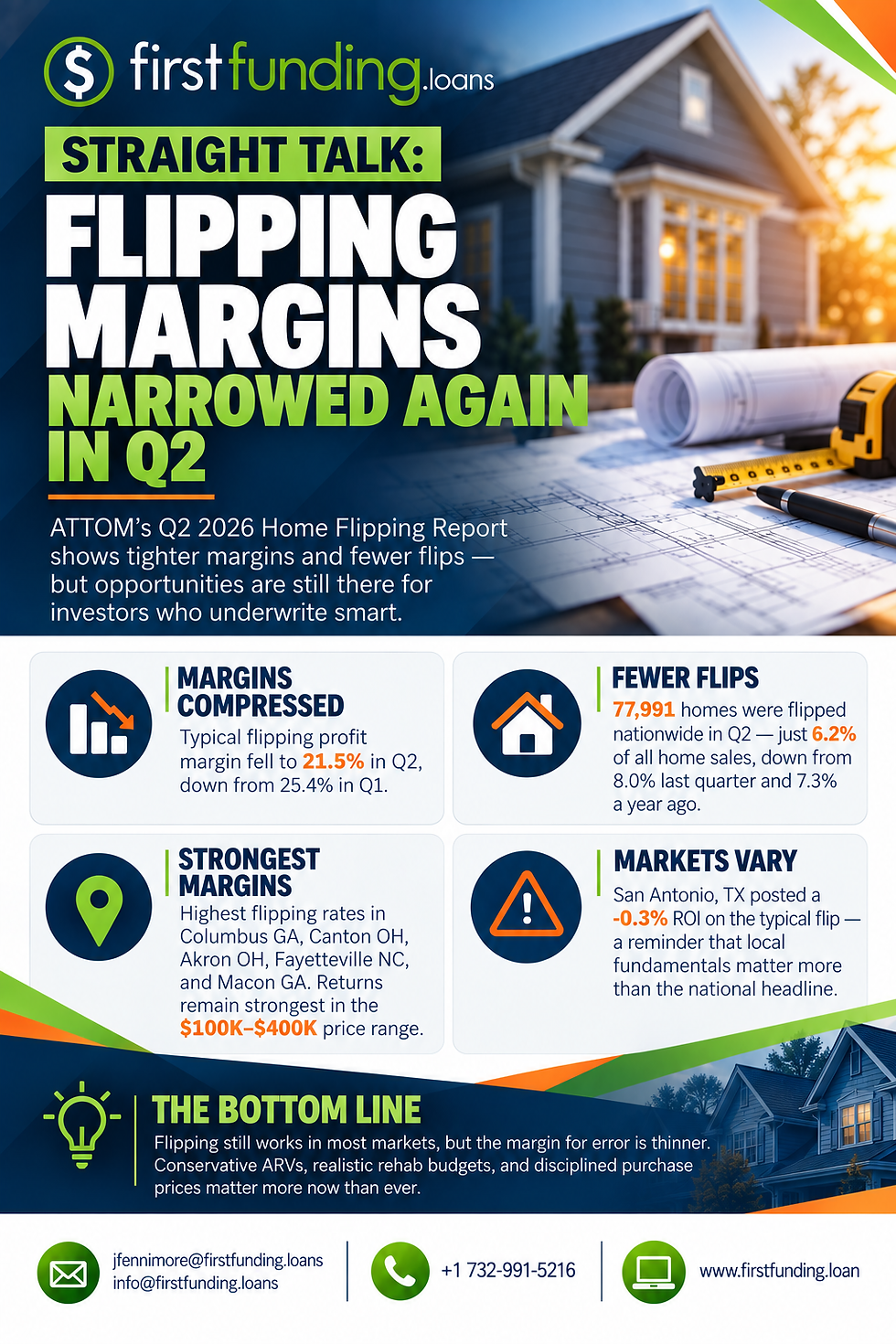
Profit Margins Remain Tight—but Conditions Are Stabilizing
There is no question that gross returns have declined from the unusually strong levels seen over the past decade. Acquisition prices, financing costs, labor, materials, insurance, and holding expenses continue to place pressure on profitability.
However, one important indicator is moving in the right direction.
Last quarter, only 17% of flippers reported selling below their expected after-repair value, compared with 21% during the previous quarter.
That improvement suggests renovated homes are selling closer to projected values. It may also be an early sign that pricing conditions are beginning to stabilize.
For investors, the takeaway is simple: conservative underwriting still matters, but the downside may be becoming more predictable.
Distressed Inventory Is Creating New Deal Flow
Foreclosure filings were up 20% year over year as of last fall, gradually expanding the pipeline of distressed properties.
These properties will not enter the market all at once. Foreclosure timelines vary significantly by state, and the process can take much longer in judicial foreclosure states. However, markets with shorter timelines may begin seeing more opportunities sooner.
For active investors, that could mean additional inventory through auctions, bank-owned properties, wholesalers, and direct-to-seller channels.
The Best Opportunities Are Hyper-Local
National averages can be misleading.
Some metropolitan areas are producing very narrow margins, while others are still generating gross returns of 70% or more. Two properties located only a few neighborhoods apart can also perform very differently based on buyer demand, renovation expectations, insurance costs, taxes, and available inventory.
The investors succeeding today are not waiting for the market conditions of 2016 to return. They are:
Building strong local relationships
Finding properties before they reach the broader market
Estimating renovation and holding costs carefully
Using realistic, neighborhood-specific resale values
Keeping total project costs within approximately 70%–75% of ARV when possible
Moving quickly when a genuinely strong opportunity appears
Today’s market rewards discipline more than optimism.
Speed Still Wins the Right Deals
Well-priced properties continue to attract serious buyers. When an opportunity works on paper, investors may have only a short window to submit a competitive offer.
That is why arranging financing before making an offer can make such a difference. It allows investors to act with confidence, demonstrate that they are prepared to close, and compete more effectively with cash buyers.
The fix-and-flip market is not disappearing—it is becoming more selective.
There are still profitable deals available, but success depends on buying correctly, budgeting realistically, and having the right financing strategy ready from the beginning.
If you have a property in your pipeline, let’s review the numbers and structure the financing so you are ready to move when the opportunity is right.


Comments